
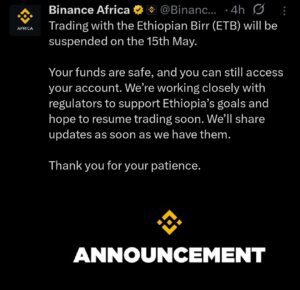
In a recent update that has caught the attention of the local financial community, Binance Africa has announced the official suspension of all trading activities involving the Ethiopian Birr (ETB), effective May 15th. According to the announcement, the decision to halt ETB pairs is part of an ongoing effort to align operations with regional regulatory standards. While the suspension limits local currency transactions, the platform has emphasized that all user funds remain secure and that account access will not be restricted for other digital asset services.
National Bank of Ethiopia Warns Against Illegal Money Transfer Services
The exchange clarified that it is currently engaged in active dialogue with Ethiopian regulators to support the country’s financial objectives. By working closely with oversight bodies, Binance expressed hope that trading services for the Birr might resume once a clear framework is established. For active traders, this move highlights the importance of managing open Peer-to-Peer (P2P) orders and liquidity positions before the mid-May deadline to avoid any service interruptions.
This development occurs at a pivotal moment for Ethiopia’s financial sector, which is undergoing significant macroeconomic reforms and modernization. As the National Bank of Ethiopia and the Ethiopian Capital Market Authority continue to refine the rules governing digital finance, the suspension of ETB trading on international exchanges underscores the transition toward a more regulated and formalized digital economy. For now, users are encouraged to stay tuned to official updates as the landscape for local cryptocurrency trading continues to evolve.
Market Analysis: Why Binance’s ETB Suspension Matters for Ethiopia’s Financial Future
The suspension of Ethiopian Birr (ETB) trading on Binance is more than a crypto-related development. It is an early indicator of structural tension between Ethiopia’s traditional financial system and the rapid rise of borderless digital finance.
For Ethiopia, the issue is not simply cryptocurrency. The real issue is control over liquidity, foreign exchange flows, monetary policy, and the future architecture of the country’s financial system.
A Parallel Financial System Was Quietly Emerging
Over the past two years, crypto usage in Ethiopia expanded far beyond speculative trading. Many users increasingly treated stablecoins such as USDT as:
a digital dollar substitute,
a store of value,
a remittance channel,
and an informal cross-border payment mechanism.
This became especially important in an economy facing:
persistent foreign currency shortages,
inflationary pressure,
exchange-rate adjustments,
and restrictions on international payments.
In practice, crypto platforms created an alternative financial rail operating outside Ethiopia’s banking system.
That is strategically significant.
Every time users converted Birr into stablecoins, part of the country’s liquidity effectively moved into a decentralized ecosystem beyond direct central bank supervision.
For regulators, this raises concerns about:
capital flight,
shadow foreign exchange markets,
reduced monetary transmission effectiveness,
and difficulty tracking cross-border transactions.
The Binance decision suggests authorities may now view crypto not merely as a technology issue, but as a macro-financial stability issue.
—
A Signal That Ethiopia’s Financial Reforms Are Entering a More Sensitive Phase
Ethiopia is currently undergoing one of the largest financial transitions in its modern history.
The country is simultaneously:
liberalizing foreign exchange systems,
developing capital markets,
expanding digital payments,
modernizing banking regulation,
and opening previously state-dominated sectors.
At the same time, decentralized finance is growing organically from the bottom up.
This creates a policy dilemma: How can Ethiopia modernize finance while maintaining monetary and regulatory control?
The suspension may indicate that regulators are attempting to slow uncontrolled digital dollarization during a delicate reform period.
If large-scale stablecoin adoption accelerates unchecked, policymakers could face:
weaker demand for Birr,
increased exchange-rate pressure,
reduced visibility into financial flows,
and diminished effectiveness of traditional banking channels.
From a macroeconomic perspective, this is less about banning innovation and more about protecting policy leverage.
—
Why Young Ethiopians Turned to Crypto So Quickly
The rapid growth of crypto adoption in Ethiopia reflects structural gaps in the formal financial system.
For many users, crypto solved real economic problems:
freelancers receiving international payments,
diaspora-linked transactions,
online commerce,
savings preservation,
and access to dollar-linked assets.
Traditional banking infrastructure still has limitations in:
international payment accessibility,
forex availability,
transaction speed,
and global interoperability.
Crypto platforms filled those gaps faster than formal institutions could.
That is why demand grew despite regulatory uncertainty.
This is a key point often missed in crypto discussions: In emerging economies, crypto adoption is frequently driven less by speculation and more by financial functionality.
—
Implications for banks and Ethiopia’s Emerging Capital Market
The development also matters for banks, fintech firms, and Ethiopia’s new capital market ecosystem.
If decentralized platforms continue attracting users and liquidity, traditional financial institutions may face increasing pressure to:
digitize faster,
improve cross-border payment systems,
expand investment access,
and modernize customer experience.
This could accelerate innovation across:
mobile banking,
digital investment products,
forex platforms,
and securities infrastructure.
At the same time, regulators may become more determined to ensure that future financial innovation occurs inside supervised institutional frameworks such as:
licensed fintechs,
banks,
and the Ethiopian Securities Exchange.
The broader contest is becoming clearer: institutional finance versus decentralized finance.
—
Ethiopia May Eventually Move Toward Regulation Rather Than Permanent Restriction
Globally, many countries initially reacted cautiously to crypto before later introducing regulatory systems.
That path often follows four stages:
1. rapid informal adoption,
2. regulatory concern,
3. temporary restrictions,
4. structured supervision and licensing.
Ethiopia may be entering the third stage.
The long-term trajectory will likely depend on:
foreign exchange stability,
digital finance growth,
institutional readiness,
and regional regulatory trends across Africa.
Rather than eliminating crypto activity entirely, authorities may eventually prefer:
registration systems,
transaction monitoring,
taxation mechanisms,
and licensed exchange operations.
That would allow regulators to maintain oversight while still benefiting from financial innovation.
—
Strategic Takeaway
The Binance ETB suspension is ultimately a signal that Ethiopia’s financial system is entering a new era where digital finance has become too economically significant to ignore.
The key question is no longer whether crypto exists in Ethiopia.
The real question is whether Ethiopia can build a regulatory and financial framework capable of integrating digital finance without weakening monetary stability, banking oversight, and foreign exchange management.
I love how fast the loading time is here. Getting my daily bonuses has never been easier than through gg7770login
Finally found an app that doesn’t lag. The registration was a breeze with no1jililoginapp. Super handy for gaming on the go.
Really impressed with the customer support here. They answered my questions almost instantly. Highly recommend giving bdjoya9official a shot.
I really appreciate the customer support here, they answered my questions almost instantly. It makes the whole experience feel very secure. Shoutout to bd88xbajee!
Smooth access and great customer support when I had a question about my account. mpoboslogin makes gaming so much easier.
This app is a game changer for me. I can play anytime and anywhere without any lag. Love the layout of 8e884app.
This place has a great vibe and the bonuses for new members are actually generous. I am having a blast so far. Visit bdxxx999 for more details.
Finally found a place where the login process is actually seamless. No more endless loading screens. Great experience so far with jili356comlogin.
The variety of games here is impressive. I spent a few hours exploring and the graphics are amazing. Definitely spending more time on br7pwin from now on.
The slots here are so addictive and the themes are really cool. I had a blast winning a few big pots last night. Check out dremjilislot today.
I love the bonuses they give to new players. It really helped me get started and build my balance. Big thanks to pkad7777 for the generosity.
Such an exciting atmosphere! The games are high quality and the rewards are actually achievable. If you like gaming, pkk999casino is a must-visit.