
Addis Bank reported a sharp decline in profitability during the 2025/26 financial year, despite recording substantial growth in deposits, assets and shareholders’ equity, highlighting the changing earnings environment facing Ethiopian commercial banks.
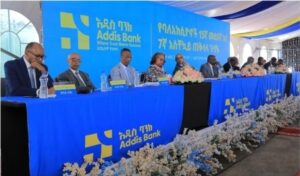
The bank posted ETB 1.78 billion in profit before tax, representing a 39.6% decline from the preceding financial year. Net profit also dropped by 38.4% to ETB 1.35 billion, according to its latest annual financial performance report presented to shareholders in November 2026.
The contrasting performance points to an important development in Ethiopia’s banking industry: balance-sheet expansion is not necessarily translating into stronger bottom-line earnings.
Strong Growth in Deposits and Assets
Despite the decline in profitability, Addis Bank continued to expand its operations.
Total assets increased by 29.6% to ETB 30.63 billion, while deposits grew by 30.5% to ETB 19.03 billion. The bank’s gross loan portfolio also expanded by 23.7% to approximately ETB 12 billion.
Shareholders’ equity rose by 47.3% to ETB 8.3 billion, while paid-up capital doubled to ETB 5 billion.
The figures indicate that the bank strengthened its financial position and expanded its capacity to mobilise deposits and extend credit. However, the slower growth in lending relative to deposits and the decline in earnings raise questions about how effectively the expanding balance sheet is being converted into income.
Foreign Exchange Gains Lose Their Momentum
The most notable factor behind the decline in profitability was the significant reduction in foreign-exchange gains.
Addis Bank’s net foreign-exchange gains fell from ETB 1.82 billion in the previous financial year to ETB 586 million in 2025/26, a decline of approximately 68%.
This development is particularly relevant in the context of Ethiopia’s ongoing foreign-exchange market reforms.
Following the introduction of the foreign-exchange market reform programme, banks experienced significant changes in their foreign-currency operations and earnings. The earlier period of exchange-rate adjustment generated substantial foreign-exchange-related gains for financial institutions.
As those gains moderated, banks increasingly faced the challenge of generating sustainable income from their traditional banking activities.
For Addis Bank, the reduction in foreign-exchange gains was substantial enough to weigh heavily on overall profitability.
Interest Income Provides Some Support
While foreign-exchange income declined, interest income moved in the opposite direction.
The bank’s interest income increased by 41.2% to ETB 2.6 billion, reflecting growth in its lending and interest-earning activities, including interbank placements and open-market operations.
This increase suggests that interest-generating activities are becoming increasingly important to the bank’s earnings structure.
However, the improvement was insufficient to offset the decline in foreign-exchange gains and the increase in operating expenses.
Operating expenses rose by approximately 29.8% to ETB 3.1 billion, creating additional pressure on the bank’s earnings.
The combination of lower foreign-exchange gains and higher operating costs illustrates the importance of improving operational efficiency as the banking industry adjusts to a changing macroeconomic environment.
Asset Quality and Capital Position
Despite the decline in profitability, Addis Bank maintained relatively strong reported capital and asset-quality indicators.
Its non-performing loan ratio stood at approximately 3%, below the National Bank of Ethiopia’s 5% regulatory ceiling.
The bank’s capital adequacy ratio reached approximately 26%, considerably above the applicable regulatory minimum of 11%.
These indicators suggest that the bank maintained a capital buffer and relatively contained reported credit risk during the reporting period.
However, sustaining these indicators will require continued attention to lending quality, capital management and the ability to generate sufficient earnings to support future expansion.
Expanding Its Presence in Interest-Free Banking
Addis Bank also continued developing its interest-free banking operations.
The bank mobilised approximately ETB 601 million in interest-free deposits, reflecting its efforts to diversify its deposit mobilisation activities and serve customers seeking Sharia-compliant financial services.
Its branch network also expanded to 172 outlets, extending its geographical presence and customer reach.
Meanwhile, export financing accounted for approximately 45.4% of its loan portfolio, underlining the importance of foreign-currency-generating economic activities in the bank’s lending strategy.
Foreign-currency mobilisation reached USD 167.1 million during the financial year, although this represented a 12% decline.
Capital Market Implications
Another important development is Addis Bank’s engagement with Ethiopia’s emerging capital market.
The bank’s registration-related activities with the Ethiopian Capital Market Authority and the prospectus process for its existing shares are relevant to the broader transition towards a regulated securities market.
As Ethiopia develops its capital market infrastructure, the registration of existing company shares represents an important step towards establishing a formal framework for securities ownership, disclosure and potential secondary-market transactions.
For shareholders and prospective investors, developments involving banks are particularly important because financial institutions are among the major corporate participants in the economy.
However, registration of shares should not be confused with an actual listing or the commencement of secondary-market trading.
A Bigger Bank, but a Profitability Challenge
Addis Bank’s 2025/26 performance reflects two contrasting realities.
On one hand, the bank expanded its assets, deposits, lending operations and capital base. On the other, its profitability declined considerably as foreign-exchange gains moderated and operating costs increased.
The coming financial years will therefore test the bank’s ability to translate balance-sheet growth into sustainable earnings.
Its ability to expand interest-generating assets, manage operating expenses, maintain asset quality and diversify revenue sources will be important in determining its future financial performance.
For Ethiopia’s banking industry more broadly, Addis Bank’s results offer an important reminder: the sustainability of bank growth will increasingly depend not only on the size of deposits and assets, but also on the quality and profitability of those assets.