
Ethiopian Capital Market Authority (ECMA) has approved the registration of 11,665,497 existing shares of Hibret Bank S.C., adding another major banking institution to the growing list of companies bringing their securities under Ethiopia’s capital-market regulatory framework.

According to a notice issued by ECMA on August 8, the Authority approved Hibret Bank’s Registration Statement on August 6, 2026, covering 11,665,497 shares already held by the bank’s existing shareholders.
The registration was undertaken pursuant to Article 75 of the Capital Market Proclamation No. 1248/2021 and Articles 4 and 29 of the Public Offer and Trading of Securities Directive No. 1030/2024.
What does the registration mean?
The development should not be confused with a new share sale.
ECMA’s notice specifically states that the announcement is made solely to notify the public of the registration of the securities and should not be interpreted as an endorsement, an offer to sell securities, or a solicitation for investors to purchase them.
In other words, the 11.67 million shares were already owned by Hibret Bank shareholders. The latest regulatory action formally brings those existing securities into the registration framework overseen by ECMA.
This distinction is particularly important as Ethiopia moves from a predominantly bank-based financial system toward a broader capital-market system in which shares and other securities can eventually be traded through regulated markets.
Hibret Bank’s registration is not an isolated development.
ECMA has been registering existing securities of banks at an accelerating pace in 2026. Recent cases include Zemen Bank, Awash Bank, Abay Bank, Bunna Bank, Gadaa Bank, ZamZam Bank, Addis Bank and Sidama Bank, among others. ECMA’s own records show a series of securities-registration notices issued throughout the year.
Some of the registrations have involved only existing shares, while others have combined registration of existing shares with approval for additional shares to be offered.
Some notable cases
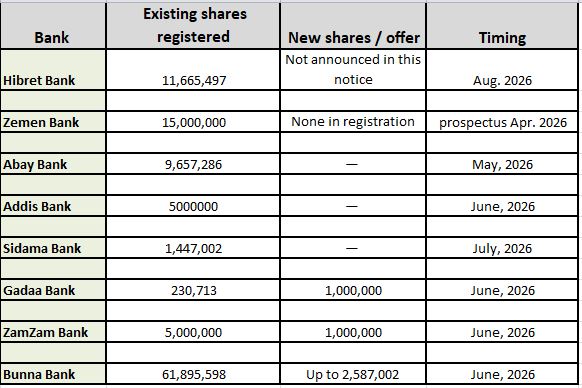
The figures illustrate an important point: registration and issuance are two different processes.
For example, Zemen Bank’s prospectus states that it intended to register all 15 million existing ordinary shares, with no new securities being issued or offered under that particular prospectus.
- Similarly, ECMA registered 9,657,286 existing Abay Bank shares in May.
- Bunna, Gadaa and ZamZam show another side of the process
Some recent cases demonstrate how registration can be accompanied by a future capital-raising component.
- Bunna Bank’s registration covered 61,895,598 existing ordinary shares, while ECMA also approved the issuance of up to 2,587,002 new ordinary shares for existing shareholders.
- Gadaa Bank provides another example. ECMA registered 230,713 existing shares and approved 1 million new shares for offering to existing and new shareholders.
- ZamZam Bank similarly had 5 million existing shares registered, alongside 1 million new shares approved for offering.
- Hibret Bank’s August 8 notice, however, refers only to the registration of its 11,665,497 existing shares. The notice itself does not announce a new share offering.
A particularly important comparison: Wegagen Bank
Another recent case demonstrates that registration can also occur in stages.
In July, ECMA registered an additional 3,876,031 existing shares of Wegagen Bank, on top of 6,218,635 shares that had previously been registered and listed. This brought the bank’s registered securities to more than 10 million shares.
The Wegagen case is significant because it shows that securities registration does not necessarily happen in one single transaction for every issuer.
Why are banks registering their shares now?
- The developments are part of Ethiopia’s broader transition toward a regulated securities market.
- The Capital Market Proclamation No. 1248/2021 established the legal foundation for the capital-market system and ECMA. The subsequent Public Offer and Trading of Securities Directive No. 1030/2024 established more specific requirements governing securities registration and public offerings.
ECMA has also published a list of share companies that had not yet registered their shares, demonstrating that securities registration is being treated as a wider regulatory-compliance issue rather than something limited to companies preparing for an immediate public offering.
Does this mean Hibret Bank is going to be listed on ESX?
Not necessarily — at least not based on this notice alone.
Registration with ECMA is an important regulatory step, but it should not automatically be described as an ESX listing or a public offering.
The distinction has become particularly relevant as Ethiopia’s securities exchange develops.
Hibret Bank has, however, already demonstrated an interest in the capital-market ecosystem. In July 2026, the bank announced a ETB 50 million investment in the Ethiopian Securities Exchange (ESX), representing a 5% ownership stake in the exchange’s paid-up capital, according to Ethiopian Business Review.
That investment makes the latest securities-registration development particularly noteworthy, although it does not by itself establish that Hibret Bank will immediately list its shares on ESX.
From private bank shares to tradable securities
The significance of the latest ECMA action therefore goes beyond the 11.67 million shares themselves.
For decades, Ethiopian bank shares have largely been traded through private arrangements among shareholders, with limited mechanisms for transparent price discovery and organized secondary-market trading.
The emerging capital-market framework is intended to change that environment by creating regulated infrastructure for the issuance, registration and eventual trading of securities.
The registration of Hibret Bank’s shares represents another piece of that infrastructure.
The bigger picture
The sequence of registrations involving major banks shows that Ethiopia’s capital-market development is moving beyond legislation and institutional establishment into actual securities registration and market preparation.
With banks such as Zemen, Abay, Awash, Bunna, Gadaa, ZamZam, Addis, Sidama, Wegagen and now Hibret Bank completing different stages of registration, the banking sector is becoming one of the principal drivers of the country’s emerging securities market.
At the same time, the recent listing of Bank of Abyssinia on the Ethiopian Securities Exchange demonstrates that the process is beginning to move from registration toward actual exchange participation.
For Hibret Bank, the immediate development is therefore a securities-registration milestone—not a public share sale. But given the bank’s investment in ESX and the rapid expansion of securities registration among Ethiopian banks, the development places Hibret Bank firmly within the country’s evolving capital-market story.
The withdrawals are surprisingly fast. I got my winnings in my wallet in no time. Great job to the phpaldopanalo team.
Really impressed with the game variety on this platform. Everything runs smoothly on my phone without any lag. Check out ph55bmwcom if you want a solid experience.
Easy registration and an even easier login process. I love that I can jump straight into the action without any hassle at nike88login.
The login process is super quick and I didn’t face any lag. It is definitely one of the best platforms I have used recently. Visit onyxlogin today.
Finally found a reliable link that actually works without any redirects. The interface is very user-friendly. Highly recommend jepor987link to everyone.
Best online casino experience in the Philippines so far. The customer support is very responsive and helpful with my deposit. Love phcash11casino.
Really impressed with the payout speed. No long waits or confusing steps, just straightforward service. Cheers to br777gg for the great experience.
If you love the thrill of the draw, you gotta try idindolottery88. It is very easy to navigate and the interface is clean.
The game variety is insane! I spent the whole weekend exploring different titles and I am hooked. Give br777games a try if you love gaming.
I’ve tried a few sites lately but this one is definitely the smoothest for logging in. Super fast and no lag at all. Check out 2phcomlogin for a great experience.
Finally found a site that actually cares about its users. The customer support team is super helpful and the bonuses are actually worth it. Love krktwin33 so far.
Really happy with the transparency of this site. No hidden fees and the registration process took me less than two minutes. vnnc88 is definitely becoming my go-to spot.
Best experience I’ve had this month. The community is great and the wins are consistent. You can’t go wrong with jljl555com for your daily gaming.