Ethiopia’s capital market regulator has outlined strict conditions for the posed domestic distribution of securities linked to Dangote Petroleum Refinery and Petrochemicals’ landmark initial public offering (IPO), restricting participation to qualified investors and prohibiting public marketing without the required regulatory authorization.
The Ethiopian Capital Market Authority (ECMA), in a public notice issued on October 13, confirmed that it had been approached in connection with the proposed offering of securities in Ethiopia associated with the Nigerian refinery’s IPO.
The announcement comes as Dangote seeks to raise approximately $1.6 billion through one of Africa’s largest planned public share offerings, creating a potential opportunity for eligible Ethiopian investors to gain exposure to a major industrial enterprise outside the domestic market.
However, the Authority made clear that the proposed Ethiopian offering is not available to ordinary retail investors. Any distribution, solicitation, marketing or sale must comply with Ethiopia’s capital market legislation, including Capital Market Proclamation No. 1248/2021 and Public Offer and Trading of Securities Directive No. 1030/2024.
The development highlights both the opportunities emerging from Africa’s increasingly interconnected financial markets and the regulatory limitations that continue to shape cross-border investment.
Dangote IPO: A major African capital-raising initiative
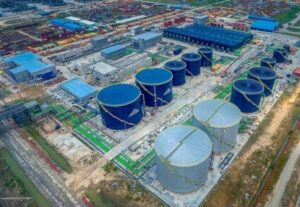
Dangote Petroleum Refinery and Petrochemicals has launched an ambitious IPO intended to expand investor ownership of its large-scale refining and petrochemical operations in Nigeria.
According to the company’s official October 12 announcement, the offering involves 4.1 billion ordinary shares priced at 525 Nigerian naira per share. The subscription period, originally scheduled to close on October 13, has been extended to October 27, 2026, following regulatory approval in Nigeria.
Target fundraising
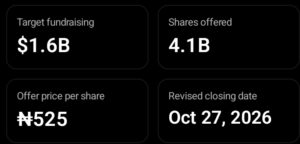
Figures relate to the broader IPO, not a separately confirmed Ethiopian allocation. Source: Dangote’s official offering announcement.
The offering is particularly significant because the refinery represents one of Africa’s largest private industrial investments. Located near Lagos, the facility has a reported processing capacity of approximately 700,000 barrels of crude oil per day.
The IPO also follows a substantial improvement in the company’s financial performance.
According to unaudited results reported by Reuters on October 13, Dangote Petroleum recorded revenue of $22.48 billion during the first nine months of 2026, compared with $9.19 billion during the corresponding period in 2025. Net profit reached $4.73 billion, reversing a $117.2 million loss recorded a year earlier.
These figures provide an important financial backdrop to the share offering, although strong historical results do not guarantee future investment returns.
ECMA establishes a strict regulatory framework
The Ethiopian regulator’s notice represents a significant clarification of how the proposed offering may be conducted within the country’s jurisdiction.
Under the framework, securities may be offered only to investors who satisfy the applicable definition of a Qualified Investor.
ECMA has imposed several specific conditions on intermediaries, representatives, capital market service providers and other entities participating in the offering.
| Regulatory requirement | Condition |
| ———————— | ——————————————————- |
| Investor eligibility | Qualified investors only |
| Number of investors | Maximum 100 without prior ECMA approval |
| Eligibility verification | Mandatory before participation |
| Advertising | Prior regulatory approval required |
| Mass marketing | Prohibited where it could reach non-qualified investors |
| Offering documents | Must clearly disclose investor restrictions |
These requirements are consistent with Article 147 of Ethiopia’s Public Offer and Trading of Securities Directive, which establishes specific conditions for offerings relying on the qualified-investor exemption.
The Authority also warned that offering securities to members of the general public without the required registration, approval or exemption could constitute a violation of Ethiopian capital market laws.
Importantly, ECMA stressed that regulatory authorization should not be interpreted as an endorsement of Dangote’s securities, the issuer’s financial condition or the investment’s potential returns.
This distinction is essential for investors evaluating a high-profile offering associated with one of Africa’s best-known industrial groups.
Who qualifies to invest?
Under Ethiopia’s securities regulatory framework, qualified investors generally include institutional investors, high-net-worth individuals and other categories recognized by the Authority.
The classification is intended to identify investors with sufficient financial capacity or sophistication to evaluate investment opportunities and associated risks.
For institutional investors, the proposed offering could potentially create opportunities to diversify investment portfolios beyond Ethiopian financial assets.
However, eligibility alone does not guarantee participation. Investors would still need to comply with the relevant subscription arrangements, documentation requirements and any additional conditions governing cross-border investment.
The ECMA notice does not identify the Ethiopian intermediaries that may participate, disclose a specific Ethiopian share allocation or establish a local subscription procedure.
Consequently, the announcement should not be interpreted as confirmation that eligible investors can immediately subscribe through a domestic institution.
A potential milestone for Ethiopia’s emerging capital market
Beyond the Dangote transaction itself, the announcement carries wider implications for Ethiopia’s developing securities industry.
The Ethiopian Securities Exchange (ESX) and the country’s evolving capital market infrastructure have created a new institutional environment for securities issuance, trading and investment intermediation.
Until recently, Ethiopia’s formal investment landscape was dominated by bank deposits, government securities, direct business ownership and relatively limited secondary-market opportunities.
The emergence of a regulated securities market is gradually changing that structure.
A cross-border transaction involving a major African industrial company could demonstrate how Ethiopian investors and licensed market intermediaries might eventually participate in a broader regional investment ecosystem.
Three implications are particularly important.
First, cross-border diversification could become increasingly relevant. Ethiopian institutional investors have historically operated within a market offering relatively few publicly tradable corporate securities. Access to qualifying foreign securities, subject to applicable approvals and foreign-exchange requirements, could eventually broaden portfolio construction opportunities.
Second, the transaction could test the readiness of local intermediaries. Facilitating international securities offerings requires investor verification, custody arrangements, settlement infrastructure, regulatory compliance and clear disclosure practices. These requirements could encourage the development of more sophisticated capital market services.
Third, Ethiopia’s regulatory approach signals a preference for controlled market access. Rather than allowing unrestricted public participation in a foreign IPO, ECMA is emphasizing investor classification, disclosure and regulatory oversight.
This approach may reduce certain investor-protection risks during the early stages of capital market development, although it also limits participation by the wider investing public.
Why the offering remains inaccessible to ordinary Ethiopian investors
One of the most notable features of ECMA’s announcement is the contrast between Dangote’s broader African fundraising strategy and the restrictions applicable in Ethiopia.
Dangote’s IPO has been presented as an opportunity to broaden ownership across African markets, including among retail investors.
In Ethiopia, however, the qualified-investor framework means that the proposed domestic offering cannot be marketed to the general public.
This distinction illustrates a broader chfallenge facing African capital markets: securities that are publicly available in one jurisdiction may face substantially different registration, marketing and distribution requirements in another.
Nigeria’s regulatory authorization does not automatically constitute authorization for a public offering in Ethiopia.
Similarly, Ethiopia’s qualified-investor provisions do not automatically eliminate foreign-exchange, custody, settlement or other legal requirements that may apply to Ethiopian participation in foreign securities.
For Ethiopian investors, the practical question is therefore not simply whether Dangote shares are available internationally, but whether a legally compliant investment channel exists for their particular circumstances.
Foreign-exchange and investment risks remain important
A further issue concerns the operational and financial implications of acquiring securities denominated in foreign currency.
For Ethiopian investors, participation in an international offering may require access to permitted foreign-exchange channels and arrangements for holding or transferring foreign securities.
The ECMA notice does not establish a foreign-exchange allocation mechanism or confirm how subscription payments and eventual investment proceeds would be processed.
Investors would also need to evaluate the underlying commercial risks associated with the refinery.
Although Dangote’s recent financial performance has improved substantially, refining remains sensitive to crude oil prices, product demand, refining margins, operational costs and international market conditions.
Currency movements could also influence investment returns when measured in Ethiopian birr.
In addition, qualified-investor securities may face resale restrictions. Article 147 of Directive No. 1030/2024 limits transfers of securities issued under the qualified-investor exemption, subject to the applicable regulatory provisions.
These considerations mean that the investment’s potential attractiveness cannot be evaluated solely on the refinery’s size, recent profitability or the prominence of its founder.
What happens next?
The immediate development to monitor is whether a formal arrangement emerges for eligible Ethiopian investors to participate in the offering.
Dangote’s official timetable now sets October 27, 2026, as the closing date for IPO applications, although the company notes that subsequent transaction milestones remain indicative.
For Ethiopia, several questions remain unanswered: whether ECMA will issue further authorization or clarification, which licensed intermediaries might facilitate participation, how securities would be held and settled, and whether a specific allocation would be made available to Ethiopian investors.
The distinction between a proposed offering and a fully operational subscription mechanism remains crucial.
ECMA’s October 13 notice confirms that the regulator has been approached concerning the offering and explains the legal conditions that would apply. It does not establish that an Ethiopian subscription channel has already been authorized.
ET Securities analysis: An early test of Ethiopia’s cross-border capital market ambitions
The proposed Dangote securities offering represents more than a potential investment opportunity in a Nigerian refinery.
It is an early indication of how Ethiopia’s emerging capital market regulatory framework may interact with major securities offerings elsewhere in Africa.
The development illustrates a potential direction for the Ethiopian investment industry: moving from a predominantly domestic financial system toward a more connected securities market capable of accommodating international investment opportunities.
Yet the immediate benefits may be limited to a relatively narrow group of sophisticated investors.
For the broader public, the significance lies primarily in the precedent that the transaction could establish for future cross-border offerings, investment services and regulatory cooperation.
Whether the proposed transaction ultimately becomes an operational investment opportunity will depend on regulatory compliance, market infrastructure and the arrangements established by the issuer and authorized intermediaries.
For now, ECMA’s message is clear: Dangote’s IPO may create an opportunity for qualified Ethiopian investors, but participation must take place within Ethiopia’s legal framework, and regulatory engagement should not be mistaken for investment approval or endorsement.
Dangote’s $1.6 Billion IPO: Ethiopia Sets Conditions for Qualified Investors
The Ethiopian Capital Market Authority (ECMA) has clarified the regulatory requirements for a proposed offering of Dangote Petroleum and Petrochemicals securities in Ethiopia.
The October 13 notice restricts participation to qualified investors, limits the offering to 100 investors without prior approval, and imposes strict requirements on marketing and investor verification.
The development raises an important question for Ethiopia’s emerging securities market: Could cross-border investment opportunities become a new area of growth for licensed capital market intermediaries?
While the proposed transaction could signal increasing integration with African capital markets, ECMA has not confirmed the launch or final authorization of an Ethiopian subscription arrangement.
The game variety here is insane! I love how smooth the interface is even on my old phone. If you love slots, you must try semesta88slot.
Best bonuses I have seen in a long time. The welcome pack is generous and really helps you get started. pkg999