
Ethiopia’s digital financial services sector has reached a new milestone, with transactions valued at ETB 33 trillion during the 2025/26 fiscal year, highlighting a fundamental transformation in how money moves through the country’s economy.
The figure, disclosed by a senior National Bank of Ethiopia (NBE) official at the Ethiopia Finance Forum on October 1, reflects the growing importance of mobile money, digital banking, and electronic payments.
But behind the headline figure lies a more consequential question for Ethiopia’s commercial banks: As digital payment platforms expand, are traditional banks losing control of customer relationships, payment transactions, and future financial-service revenues?
The answer is more complicated than the rapid growth of mobile money might suggest. Banks remain central to Ethiopia’s financial system, but the competition for payment services, customer data, and digital distribution is intensifying.
Digital payments have more than tripled in two years
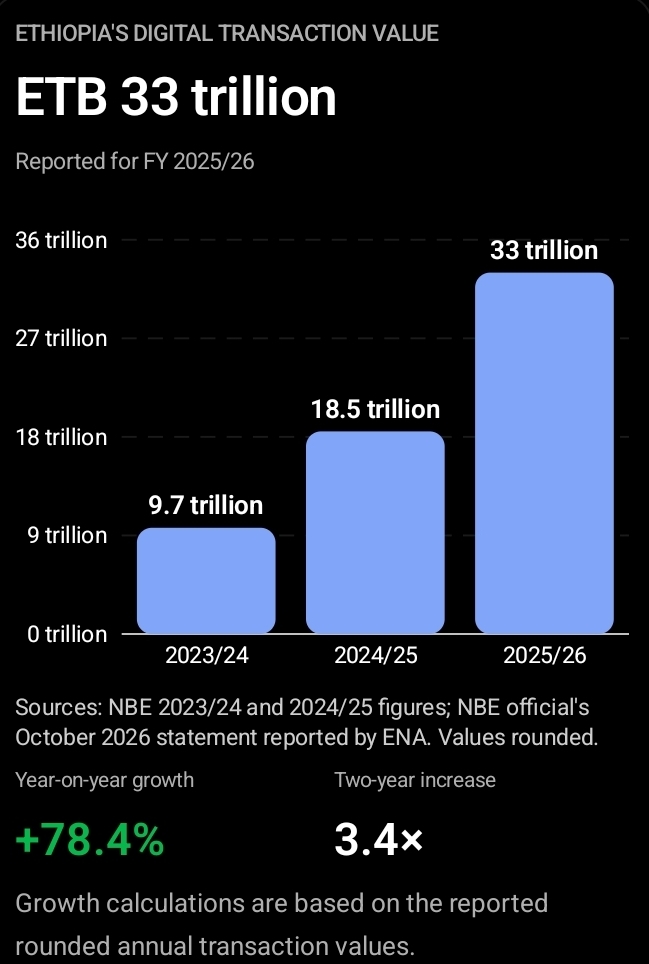
According to NBE’s earlier disclosures, digital transactions were valued at approximately ETB 9.7 trillion in 2023/24, increasing to more than ETB 18.5 trillion in 2024/25. The latest ETB 33 trillion figure represents an increase of approximately 78.4% from the previous year.
This acceleration demonstrates that digital financial services are becoming an increasingly important component of Ethiopia’s financial infrastructure.
However, transaction value should not be confused with bank deposits, revenue, or new money entering the economy. The same funds can be transferred or spent multiple times, contributing repeatedly to the annual transaction total.
Mobile money is changing the competitive landscape
For decades, Ethiopian commercial banks dominated formal financial transactions through their branch networks, deposit accounts, and payment services.
That model is changing.
Mobile money operators and other payment service providers have created alternative channels through which individuals and businesses can transfer funds, pay merchants, and access financial services without visiting a bank branch.
The expansion of these platforms introduces competition in areas that traditionally reinforced banks’ relationships with customers.
For example, a customer may maintain a commercial bank account for savings or salary payments while relying on a mobile money wallet for everyday transactions. In such cases, the bank retains the deposit relationship but may no longer control the customer’s primary payment experience.
This distinction matters because frequent customer interactions can influence loyalty, transaction-fee opportunities, and access to commercially valuable payment information.
Nevertheless, mobile money providers are not necessarily replacing banks. Their services can complement banking products through account-to-wallet transfers, settlement arrangements, and partnerships.
The competitive challenge is therefore not simply about whether customers choose banks or mobile money providers. It is increasingly about which institution becomes the customer’s preferred financial platform.
The biggest threat to banks may be the loss of transaction relationships
Ethiopia’s digital finance expansion raises a strategic issue that extends beyond the growth of electronic payments.
Traditional banks depend on deposits to finance lending and other income-generating activities. They also use transaction accounts to build relationships with customers, identify financial needs, and cross-sell products.
When customers increasingly conduct everyday transactions through independent payment platforms, banks risk becoming less visible in those relationships.
Three potential consequences deserve attention.
First, banks may face pressure on certain transaction-related fees as payment providers compete on convenience and pricing.
Second, payment providers that interact frequently with customers could develop valuable insights into spending patterns and merchant activity. Subject to appropriate consent and data-protection rules, these insights could support new financial products.
Third, banks may need to invest more heavily in technology, partnerships, and customer experience to defend their market positions.
However, the available aggregate transaction figures do not establish that banks have already lost market share. That conclusion would require provider-level transaction data, revenue figures, and comparable customer-activity statistics.
Ethiopia’s digital financial ecosystem in numbers
NBE’s March 2026 Financial Stability Report provides a useful picture of the expansion of digital financial services through June 2025.
| Indicator | June 2024 | June 2025 |
| ————————- | ————- | ————- |
| Mobile money accounts | 107.5 million | 135.9 million |
| Mobile banking accounts | 39.6 million | 54.0 million |
| Internet banking accounts | 12.2 million | 15.7 million |
| POS terminals | 14,030 | 19,638 |
| Mobile money agents | 415,084 | 540,421 |
Source: National Bank of Ethiopia, Financial Stability Report, March 2026.
The figures show substantial growth in access to digital financial services.
Mobile banking accounts increased by 36.4%, while mobile money accounts grew by 26.4% during the period. The number of mobile money agents expanded by 30.2%.
Yet the growth in registered accounts should not automatically be interpreted as an equivalent increase in active users.
A single individual may hold multiple accounts across different providers.
More importantly, NBE’s draft National Digital Payments Strategy 2026–2030 identifies low account activity as a continuing challenge. According to the strategy, only 15% of accounts and 25% of agents are active, underscoring the difference between expanding access and achieving meaningful usage.
This presents a significant commercial challenge for banks and fintech providers alike.
The next phase of competition may depend less on how many accounts institutions register and more on how frequently customers use those accounts.
Can digital finance strengthen rather than weaken banks?
Despite the competitive pressures, the expansion of digital finance also presents considerable opportunities for commercial banks.
Digital transactions can reduce dependence on expensive physical infrastructure, potentially lower cash-handling costs, and improve operational efficiency.
Banks can also use digital channels to reach customers in areas where establishing conventional branches may not be economically attractive.
For Ethiopian banks, the opportunity extends beyond payment processing.
Transaction information, when used responsibly and within applicable data-protection requirements, can help institutions understand customer cash flows and develop financial products better suited to individuals and small businesses.
For example, reliable transaction histories may support improved credit assessments for merchants who lack conventional financial statements or sufficient collateral.
Digital platforms could therefore become important channels for expanding small-business lending, mobilizing savings, and distributing financial products.
However, realizing these benefits requires investment in technology, data management, cybersecurity, and appropriate risk controls.
Banks that treat digital services primarily as supplementary transaction channels may struggle to capture the full commercial value of digital transformation.
Those that integrate digital payments with savings, credit, and customer relationship management could be better positioned to compete.
NBE’s next strategy places greater emphasis on usage and interoperability
The central bank’s digital payments agenda reflects the changing requirements of the financial sector.
Under its draft National Digital Payments Strategy 2026–2030, known as BRIDGE 2030, NBE identifies six strategic priorities covering payment infrastructure, financial inclusion, adoption, human capacity, security, and innovation.
The proposed framework emphasizes interoperability between providers, stronger merchant payment networks, wider access to digital services, and improved consumer protection.
It also identifies significant structural barriers, including low digital literacy, limited merchant acceptance, cybersecurity threats, and disparities in access between rural and urban populations.
For banks, interoperability presents both an opportunity and a competitive challenge.
A more interconnected payment system can make it easier for customers to move funds between banks, mobile wallets, and other financial platforms.
That may increase overall transaction activity and improve financial inclusion.
At the same time, easier transfers between providers could reduce the advantages institutions previously enjoyed from keeping customers within their own payment networks.
As digital infrastructure becomes increasingly shared, institutions may need to compete more aggressively on service quality, pricing, reliability, and product innovation.
Cybersecurity becomes a financial stability concern
The rapid increase in digital transaction values also raises questions about the resilience of Ethiopia’s financial infrastructure.
As more payments move through electronic channels, operational disruptions, cyberattacks, fraud, and system failures can have broader economic consequences.
A significant payment-system outage, for example, could disrupt business transactions, prevent customers from accessing funds, and create liquidity pressures for affected institutions.
NBE has already highlighted these concerns.
Its March 2026 Financial Stability Report warned that rapid digital financial services growth increases exposure to operational, cybersecurity, and fraud-related risks.
The report emphasized the need to strengthen technological infrastructure, human capacity, and risk management frameworks.
For commercial banks, cybersecurity is therefore becoming more than an information technology responsibility.
It is increasingly connected to operational continuity, customer confidence, regulatory compliance, and financial stability.
The expansion of digital transactions will require corresponding improvements in fraud monitoring, transaction security, incident response, and cooperation between financial institutions and payment infrastructure providers.
What does ETB 33 trillion mean for Ethiopia’s economy?
Beyond the banking sector, the expansion of digital payments could have wider economic implications.
Electronic transactions can make payments faster, reduce some costs associated with cash handling, and improve the traceability of commercial activity.
For businesses, digital payment acceptance may improve transaction records and simplify financial management.
For policymakers, greater use of formal payment channels could potentially improve the availability of economic data and support efforts to broaden financial inclusion.
However, digital transaction growth alone is not proof of increased economic output or financial inclusion.
A rise in transaction values may reflect higher prices, repeated transfers of existing funds, greater adoption of electronic channels, or a combination of these factors.
To assess the broader economic impact, policymakers and financial institutions would need to examine transaction volumes, active users, merchant adoption, geographic coverage, and the share of payments replacing cash.
The distinction is particularly important in an economy where access to reliable connectivity, digital literacy, and formal financial services remains uneven.
The next competition: Who owns the customer relationship?
Ethiopia’s ETB 33 trillion digital transaction milestone represents more than the growth of a new payment channel.
It signals a gradual change in the structure of financial-service delivery.
Commercial banks remain essential to deposit mobilization, credit creation, and financial intermediation. Mobile money operators and other payment providers, meanwhile, are expanding the ways customers interact with financial services.
The future is unlikely to be defined solely by competition between banks and fintech companies.
Partnerships, shared infrastructure, and integrated financial products could become equally important.
For banks, the strategic question is whether they can translate their existing financial strengths into compelling digital services.
For fintech providers, the challenge is whether growing transaction activity can translate into sustainable revenues, active customer relationships, and broader financial inclusion.
And for regulators, the priority will be ensuring that innovation proceeds alongside financial stability, competition, cybersecurity, and consumer protection.
Ethiopia’s digital financial transformation is accelerating. The institutions that benefit most may not simply be those processing the largest transaction values, but those capable of converting digital activity into trusted transactions.
Clean design and no annoying pop ups. Just a pure gaming experience which is exactly what I need. Visit idtemposlot for some quality time.
Superb service and a very welcoming community. I had a small issue with my account but it was sorted in minutes. bangladeshjaya9 is truly professional.
Really impressed with the betting odds on this platform. It feels fair and the updates are instant. I’m sticking with br3355bet46 from now on.
Such a fun place to spend some time and make some extra cash. The community is great and the games are fair. Visit 888fbapp now.