
Dangote’s $4B Gode Bet: A High-Stakes Litmus Test for Ethiopia’s Economic Shift
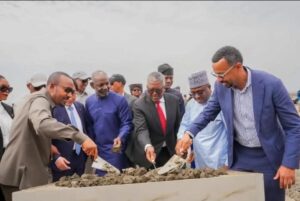
When Aliko Dangote stood alongside Prime Minister Abiy Ahmed in Gode, Somali Region, to announce a massive ramp-up of his investment from an initial $2.5 billion to over $4 billion, it turned heads across the continent’s financial capitals. This isn’t just an expansion of a corporate footprint; it’s a massive, real-time bet on the structural viability of Ethiopia’s ongoing macroeconomic overhaul. The expanded project scope is telling. We are no longer just talking about a downstream fertilizer facility. Dangote is building a fully integrated heavy industrial ecosystem, locking in a 110-kilometer natural gas pipeline from the Ogaden Basin, a dedicated 120 MW power plant, a polypropylene packaging facility, and a 2-million-ton NPK blending plant alongside the anchor 3-million-ton annual urea complex.
By taking up nearly 9% of Dangote Group’s entire Africa-wide investment budget between now and 2030, Ethiopia has officially become the group’s second-largest investment destination after Nigeria. This represents a seismic shift. For an economy historically defined by state-driven development and closed capital structures, the joint venture—structured as a 60/40 split between Dangote and the sovereign wealth fund, Ethiopian Investment Holdings (EIH)—strikes directly at the country’s most painful, compounding macroeconomic bottleneck: the structural drain on foreign exchange.
The FX and Agricultural Equation
Every year, the federal government is forced to burn through hundreds of millions of dollars in scarce hard currency reserves to import chemical fertilizer. It is an unavoidable financial trap. Agricultural productivity sustains over 70% of the population and drives the country’s export ledger through coffee and oilseeds, yet the entire sector remains completely vulnerable to global supply shocks and volatile shipping costs. When fertilizer shipments are delayed or priced out of reach, local crop yields suffer, inflation spikes, and rural incomes collapse.
Localizing primary inorganic fertilizer production at this scale fundamentally alters that equation. By leveraging domestic natural gas through a 25-year supply agreement secured with China’s GCL Group, the Gode complex bypasses the international supply chain entirely. It stabilizes input pricing for millions of smallholder farmers and helps protect rural livelihoods from external shocks. More importantly for central bankers, it stops the bleeding of foreign currency reserves at the National Bank of Ethiopia, converting a structural import liability into a potential regional export asset aimed at neighboring East African markets.
Looking past the immediate agricultural benefits, the geographical placement of the project in Gode carries immense strategic weight. Historically underindustrialized and viewed as an economic periphery, the Somali Regional State is being repositioned as a heavy industrial hub. A project scaling past $4 billion forces infrastructure acceleration that traditional regional development budgets could never achieve. The logistics corridors, energy distribution networks, and employment clusters generated by an anchor plant of this magnitude tend to draw in secondary manufacturing, transforming local supply chains and shifting regional economic dynamics from the ground up.
A Psychological Anchor for Capital Markets
What makes this investment particularly fascinating to track from a corporate finance perspective is how it intersects with Ethiopia’s financial liberalization agenda. For the nascent Ethiopian Securities Exchange (ESX) and the broader capital market ecosystem, a project of this magnitude serves as a vital psychological anchor. To put it bluntly, projects scaling toward the $4 billion mark cannot rely indefinitely on traditional domestic bank lending. The local commercial banking sector simply does not have the single-borrower capacity or the long-term liquidity to absorb the debt requirements of multi-billion-dollar industrial infrastructure without crowding out the rest of the private sector.
Large-scale, capital-intensive infrastructure projects naturally demand deep, sophisticated capital markets. They require the issuance of corporate bonds, structured project finance, commercial paper, and long-term institutional debt. As the ESX builds out its regulatory frameworks and looks to attract international and domestic institutional funds, having a credible, cash-generating mega-project tied to a regional industrial titan like Dangote changes the narrative. It provides a concrete case study for how private corporate debt can be structured in a newly liberalized market, giving international investors the confidence blueprint they need to deploy capital into frontier markets.
The Realities of Execution
Of course, any seasoned observer of East African industrial execution knows that high-profile project announcements and site visits are only half the story. The operational road toward the plant’s target completion dates will have to navigate deep, systemic headwinds:
Logistical and Infrastructure Integration:
Moving millions of tons of industrial output out of the Somali region requires flawless execution of heavy transport corridors. The construction of the 110-km pipeline and the 120 MW power station must hit strict technical milestones to prevent the kind of delayed commissioning that frequently plagues mega-projects across Africa.
Macroeconomic Transition Friction:
The project is being built during a highly sensitive transition period characterized by foreign exchange liberalization and banking sector modernization. Managing currency fluctuations, equipment import clearance, and profit repatriation mechanics will require consistent regulatory clarity and minimal administrative friction from federal authorities.
Long-term Security and Stability:
Maintaining investor and operational confidence over a multi-decade horizon requires a stable, predictable local security environment to safeguard critical assets like pipelines and power infrastructure.
The Bigger Picture: Africa Betting on Africa
Ultimately, the most significant aspect of Dangote’s expanded commitment is its origin. For decades, multi-billion-dollar heavy industrial infrastructure across East Africa followed a familiar financing script, leaning almost exclusively on Western development finance institutions, Gulf capital, or Chinese state-backed loans.
This is a distinctly intra-African capital story. It signals that Africa’s largest conglomerates are maturing to the point where they can look across borders, evaluate complex macroeconomic reforms, and deploy billions of dollars of balance-sheet capital into neighboring markets. If Dangote can successfully execute this complex integrated project, it will serve as the definitive proof of concept for global institutional capital sitting on the sidelines—proving that Ethiopia’s pivot toward a market-oriented economy is not just a theoretical policy paper, but a highly investable reality.
Really impressed with the payout speed here. It is hard to find a platform that actually pays out fast these days. Glad I found brpk44.
Found this site last week and I am loving the variety of games. The bonuses are actually fair and easy to claim. Check out starwin88login if you want a legit spot.
The mobile app version is a game changer. I can play whenever I want without any lag. For the best mobile experience, you need 119betapp.
The VIP treatment here is the real deal. I feel valued as a player and the support team is always helpful. afunbetvip is where it’s at for serious players.
If you love slots then this is the place to be. The graphics are stunning and the wins feel rewarding. Log in at ggplay88slotlogin and see for yourself.
I’ve been trying a few different sites lately and this one really stands out. The interface is smooth and the payouts are surprisingly fast. Definitely a solid choice for anyone looking for a reliable spot. Check out pk92go11
The game variety here is insane. I spent the whole weekend exploring different slots and the bonuses are actually fair. Check out ve88game for a great time.
Finally found a platform that doesn’t lag during the peak hours. The interface is super intuitive for new players. Great job on ph85ph!
Finally found an app that doesn’t crash every five minutes. The interface is super clean and easy to navigate. Just downloaded ak777apk and I’m already loving the vibe.
The slots are incredibly addictive and the graphics are top notch. I managed to hit a nice win today thanks to mustang77slot
Best slot experience I’ve had in a while. The RTP seems decent and the animations are great. Check out bolaslot888 if you’re feeling lucky today.
Best betting options for local players. The odds are competitive and the app is very user friendly. Big thumbs up for ph1xbetph.